

Capital Fortress: Opposition’s Supreme Court March Triggering Unprecedented Security Lockdown in Delhi
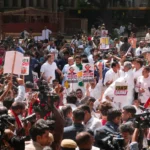
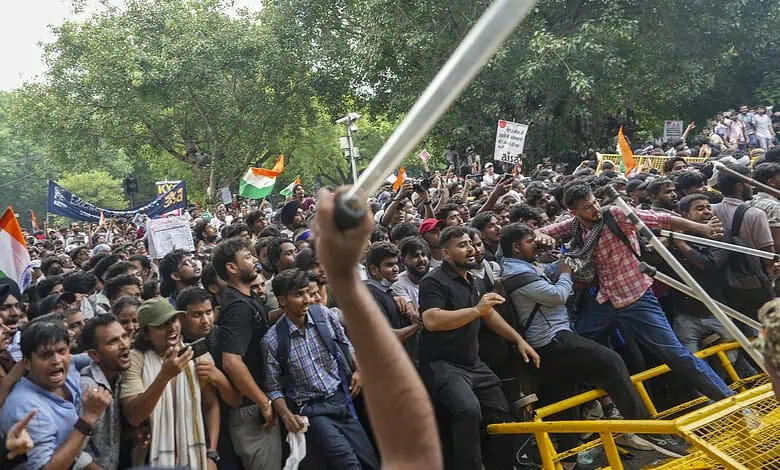
The national capital turned into a heavily militarized fortress on Monday as authorities raised security readiness to its highest alert level, mobilizing tens of thousands of security personnel, multi-tier barricades, and rapid deployment teams to halt an opposition-led protest march advancing toward the Supreme Court of India.
The agitation, spearheaded by major constituents of the opposition INDIA bloc, marks an unprecedented confrontation between the combined parliamentary opposition and the constitutional machinery governing India’s electoral apparatus. At the epicenter of this mounting storm is Chief Election Commissioner Gyanesh Kumar, whose immediate resignation the opposition has demanded over claims of systemic voting irregularities and institutional bias.
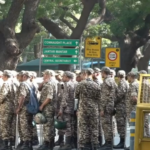
- Heavy Security Deployment: More than 30,000 police personnel and Central Armed Police Forces (CAPF) mobilized throughout Lutyens’ Delhi and inter-state border corridors.
- Public Transit Restrictions: Entry and exit gates at six key Delhi Metro stations shut to regulate pedestrian transit.
- Direct Constitutional Appeal: INDIA bloc leaders marching directly toward the Supreme Court to press for intervention and the CEC’s resignation.
- Vigil Along Borders: Multi-layered vehicular checkpoints stationed at Tikri, Singhu, Ghazipur, and Badarpur borders.
Lutyens’ Delhi Sealed as 30,000 Personnel Guard Corridors
From the break of dawn, standard commuter life across the heart of New Delhi was largely suspended. Paramilitary forces clad in anti-riot armor, water cannons, anti-tear equipment, and heavy steel barricades encircled the apex court complex, India Gate, and the broader Central Vista perimeter. Drone reconnaissance units buzzed overhead, continuously transmitting footage to centralized police command headquarters to intercept scattered groups attempting to convene near the judicial compound.
To prevent spontaneous assembly, Delhi Metro authorities placed operational restrictions across central lines. While train operations ran as scheduled through the core corridors, entry and exit portals at six designated metro stations were barricaded, compelling thousands of routine office-goers and university scholars to take alternative routes and deal with heavy vehicular gridlock along alternate ring arteries.
The Core Grievance: Opposition Accuses Election Commission of Bias
The catalyst behind Monday’s escalating face-off follows a multi-day build-up of public demonstrations across key metropolitan sectors. INDIA bloc conveners have alleged that the Election Commission under Chief Election Commissioner Gyanesh Kumar has systematically compromised transparent oversight, dismissed discrepancies in digital voter rolls, and exhibited partisan leniency.
Opposition figures claimed their move to physically march toward the Supreme Court reflects the exhaustion of standard grievance avenues. Lawmakers argued that since the poll body remains constitutionally autonomous, the judiciary remains the sole legal and moral arbiter capable of restoring democratic transparency and institutional trust.
Apex Court’s Caution on Proportionality and Citizen Rights
The massive administrative clampdown comes against the backdrop of earlier judicial observations where the Supreme Court warned the government against arbitrary, heavy-handed measures. A bench headed by Chief Justice of India Surya Kant had explicitly urged the administration to respect the “principle of proportionality,” observing that security protocols should not resemble using a “hammer to kill a fly” when ordinary citizens need routine mobility and access to transport networks.
While police officials defended Monday’s stringent security perimeter as an imperative public order safeguard to stop thousands from swarming sensitive judicial infrastructure, critics and legal observers continue to scrutinize the blanket curtailment of peaceful assembly. The administration’s recent steps to alter longstanding demonstration points, including removing Jantar Mantar as an authorized venue, have drawn backlash from civil rights advocates who see it as a shrinking of peaceful democratic assembly spaces.
Border Vigil Tightened Across the National Capital Region
Extending beyond the bureaucratic heart of New Delhi, strict vigilance has been clamped across the Delhi-Haryana and Delhi-Uttar Pradesh border posts. Vehicles entering the National Capital Region from neighboring Punjab, Haryana, and western Uttar Pradesh were subjected to thorough boot searches and identification checks to identify mobilization efforts by student organizations and farm unions.
Major transport terminals, including New Delhi Railway Station, Hazrat Nizamuddin, and Anand Vihar Inter-State Bus Terminal (ISBT), saw heavy CISF and railway police pickets conducting systematic frisking of passengers. Several regional student federations that attempted to stage solidarity sit-ins on campus lawns were promptly cordoned by security detachments.
The Road Ahead: Democratic Parity Under the Spotlight
As both sides remain entrenched, the political landscape in New Delhi approaches a high-stakes constitutional juncture. The government maintains that the Election Commission functions as a protected constitutional authority immune to street-level coercion, warning that attempts to blockade judicial premises will face firm legal action.
The INDIA bloc, however, has indicated that today’s march is only the opening chapter of a wider nationwide agitation. As civil society, legal bodies, and citizens watch closely, the focus now turns to whether the apex court will formally address the petitions filed regarding electoral oversight, or whether New Delhi must prepare for extended days of urban friction and political confrontation.