

Amit Shah Chairs 28th Western Zonal Council Meeting; Labels Region the “WEST Engine” of India’s Growth
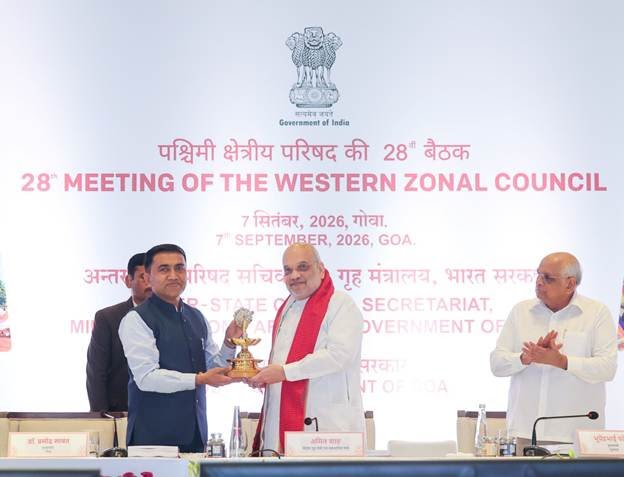
Union Home Minister and Minister of Cooperation, Shri Amit Shah, chaired the 28th meeting of the Western Zonal Council in Panaji, Goa, on Monday. Highlighting the region’s critical economic contributions, he characterized the Western Region as the nation’s largest industrial, financial, and commercial engine.
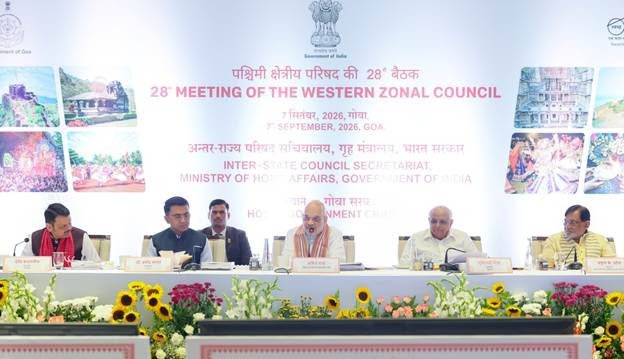
The high-level meeting was attended by Goa Chief Minister Dr. Pramod Sawant, Gujarat Chief Minister Shri Bhupendra Patel, Maharashtra Chief Minister Shri Devendra Fadnavis, and the Administrator of Dadra and Nagar Haveli and Daman and Diu, Shri Praful K. Patel, alongside senior officials from central and state administrations.
Addressing the gathering, Shri Shah noted that India recorded a GDP growth rate of 7.8% in Q1 of FY 2026–2027 amidst global turbulence. He emphasized that Goa, despite its compact size, punches significantly above its weight through robust tourism, high per capita income, and mining.
The “WEST” Growth Model
The Home Minister outlined the strategic significance of the Western Zonal Council states through the “WEST” framework, representing sectors where the region dominates national share:
Wealth & Finance: Anchor of financial capital, led by Mumbai’s position as a global financial centre.
Exports & Ports: Major maritime gateways, led by Gujarat’s Mundra and Deendayal cargo ports.
Start-ups & Semiconductors: Maharashtra leads nationally with 33,872 start-ups; Dholera emerges as a semiconductor hub.
Tourism & Blue Economy: Major coastal tourism hub, with Goa drawing over 1 crore annual visitors.
Strengthening Cooperative Federalism
Reflecting on the evolution of inter-state governance, Shri Shah pointed out that Zonal Councils have transitioned from venues of inter-state disputes to platforms for policy execution and monitoring public welfare delivery. He noted that the Western Region currently operates with zero active inter-state disputes.
Zonal Council Efficiency Milestones
- Meeting Frequency: 71 meetings held since 2014, compared to 25 meetings during 2004–2014—nearly a three-fold increase.
- Dispute Resolution: Out of 1,893 issues raised, 1,445 have been successfully settled.
- PACS Modernization: High computerization rates achieved in Primary Agricultural Credit Societies, with Maharashtra reaching 98% and Gujarat at 92%.
Security, Digital Integration, and Public Welfare
The Home Minister called for leadership from western states in adopting the New Nyaya Sanhitas and accelerating nationwide anti-narcotics efforts. On digital financial security, he urged states to integrate Urban Cooperative Banks with the Central Fraud Registry system (CFCFRMS / FCFRS), the Indian Cyber Crime Coordination Centre (I4C), and tools like MuleHunter AI.
Over the next two years, the Ministry of Home Affairs plans to significantly enhance coastal security infrastructure. Concluding the session, discussions covered critical national and regional priorities, including:
- Expediting Fast Track Special Courts for cases of violence against women and children.
- Implementation progress of the Emergency Response Support System (ERSS-112).
- Tackling child malnutrition via Poshan Abhiyaan and tracking welfare delivery under Ayushman Bharat.
- Expanding physical banking facilities to cover all rural areas within specified service radiuses.
- Urban master planning, clean energy acceleration, and adopting data center infrastructure incentives.